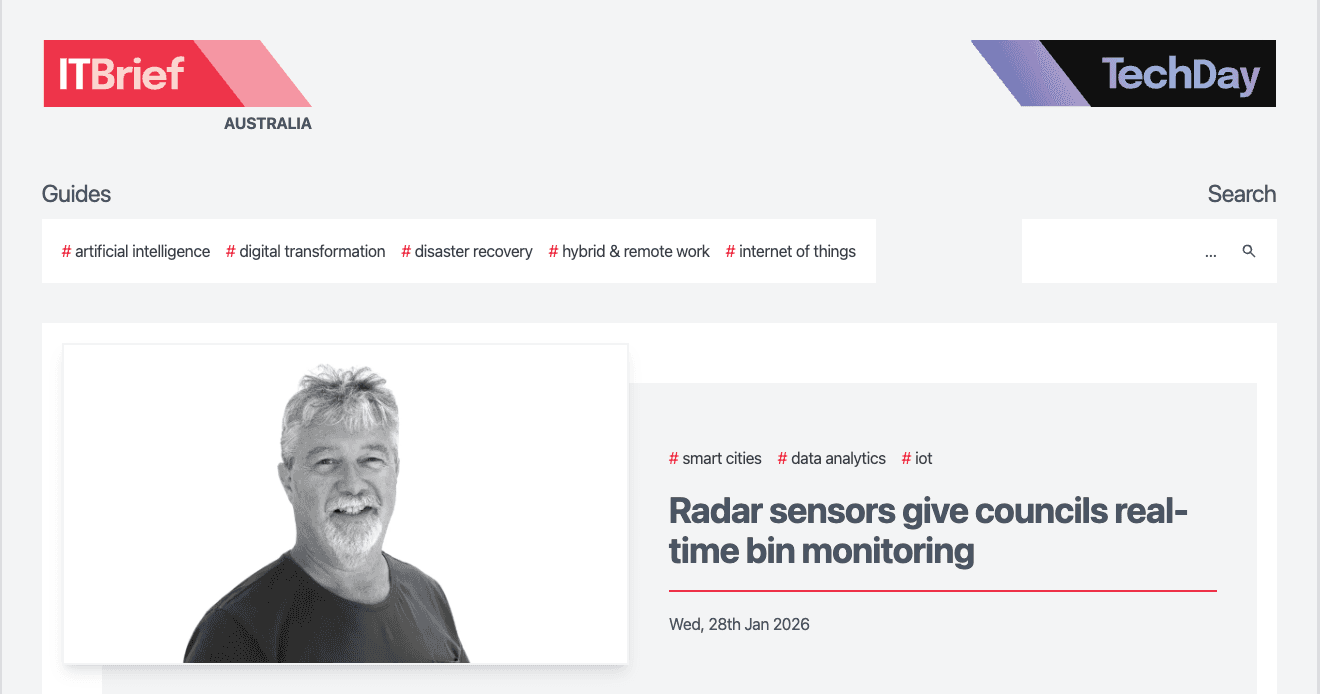
Matter, an Australian waste-technology company, has set out its case for real-time monitoring of public litter bins using small radar sensors as councils face repeated overflows at beaches and other high-traffic sites.
Len Luxford, Director at Matter, said many public waste services still rely on manual checking and fixed collection routes. He linked that approach to overflowing bins after peak periods such as long weekends and major events.
"The current system of how we empty bins in public spaces is outdated and relies heavily on people-power to physically monitor and remove waste - but that usually doesn't occur until bins are full or overflowing," said Len Luxford, Director, Matter.
Real-time data
Matter said it has developed a radar-based sensor designed to sit inside a bin and measure fill levels. Luxford described it as an "invisible radar sensor" with high measurement accuracy. He said the unit produces real-time data on current fill levels and expected time to full.
"We've been able to advance sensor technology to develop an Australian-first - an invisible radar sensor that is millimeter accurate, providing real-time, evidence-based data on how much waste is in a bin and when it is likely to be full," said Luxford.
Luxford said the product's small size and placement reduces exposure and makes it less prone to interference. He also said the design reduces the risk of vandalism and damage, compared with more visible hardware.
"Waste management is now simpler and more efficient, reducing costs and wasted labour, and the discrete design makes it vandal and damage resistant - providing use longevity," said Luxford.
Collection planning
For councils, the operational pitch centres on collection scheduling and dispatch decisions. Luxford argued that a live view of which bins are filling fastest could change how crews respond during peak demand, including around beaches, parks and event precincts.
"By monitoring bin use in real time, organisers can get a better understanding of which bins are filling and how quickly, ensuring waste removal is targeted and timely, instead of ad-hoc, or worse - set on an ill-informed schedule," said Luxford.
Matter said real-time monitoring can also feed longer-term planning decisions. The company pointed to the use of historical data for placement decisions, signage, and understanding when specific bins experience heavier use, such as weekends or seasonal peaks. It also highlighted service verification through time-stamped collection records, and emissions reduction through route optimisation and fewer unnecessary collections.
Design claims
Waste sensors already exist in the market, including ultrasonic and infrared systems used by councils and private waste contractors. Matter framed its approach around smaller hardware and long battery life. Luxford said the product can scale across fleets of bins without consuming internal capacity that would otherwise hold waste.
"No longer are sensors big clunky boxes that take up vital bin space, these are the size of a fingernail and able to withstand the conditions - and waste - found in a bin," said Luxford.
He also said battery life can run for years, with a potential ceiling of 16 years depending on use. He positioned that as a factor in ongoing operating costs and the practicality of large deployments. Matter said it holds global patents related to the technology.
"Coupled with being millimeter accurate, they're now a viable, affordable piece of technology for councils, businesses and the general consumer," said Luxford.
Council results
Matter cited council feedback on resident complaints and workforce activity after deployments. It pointed to Queensland's Cassowary Coast Regional Council as an example and said the council recorded fewer waste-related complaints and fewer crew dispatches.
"Cassowary Coast Regional Council in Queensland, for example, has reported a 72% drop in waste management complaints, and an almost 80% decrease in waste management crew dispatchment," said Luxford.
He said those results show how bin-level data can change operational decision-making and the public experience in areas with heavy footfall.
"These are significant numbers and show the real-world impact of the technology," said Luxford.
Alongside operational efficiency, Luxford also framed the technology as a tool for reporting and oversight, particularly where councils face scrutiny over service levels in public spaces during holiday periods.
"It also equips councils to have supporting evidence for how rate-payers funds are being used in waste management, which provides greater transparency and accountability for residents," said Luxford.