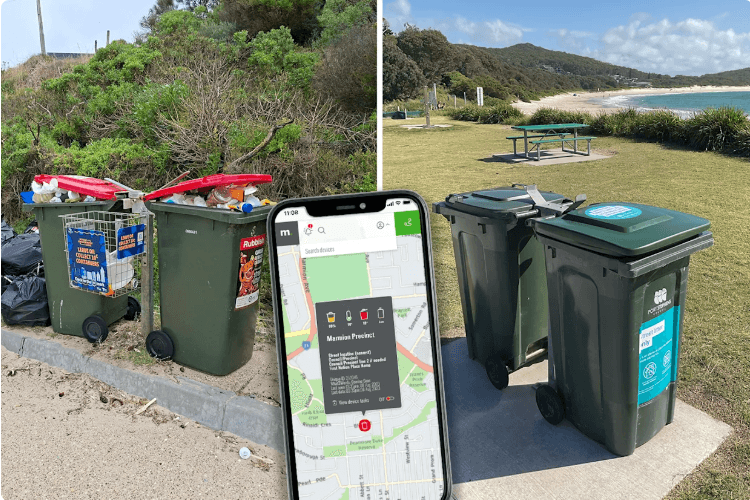
Bins around popular Aussie tourist spots will be overflowing this long weekend. That’s exactly what happened over Christmas and the New Year, when thousands flocked to the coast, pushing amenities to capacity.
But the creators of a $99 bin device claim their product could save councils the embarrassment of having dirty beaches, and fish, dolphins, seabirds and turtles from being overrun with plastic chip packets, cans, and straws.
Australian waste-tech company Matter has developed a small radar system called ThinkOS, with a chip about half the size of a fingernail, that can be embedded in the plastic bin lid.
It sends down a radar wave which checks the height of the rubbish inside and notifies councils via an app when to empty their bins, stopping them from overflowing.
The company’s director, Len Luxford, told Yahoo News it’s now being used by councils on the Cassowary Coast in Queensland, Port Stephens in NSW, and Monash in Melbourne, along with commercial businesses.
“It’s been tested in different environments, the radar technology loses little power, and it’s affordable,” he said, noting a small business could buy a lid and then get updates starting at $2 a month.
Because the sensor is deep in the plastic, they are hidden from view and unlikely to be stolen.
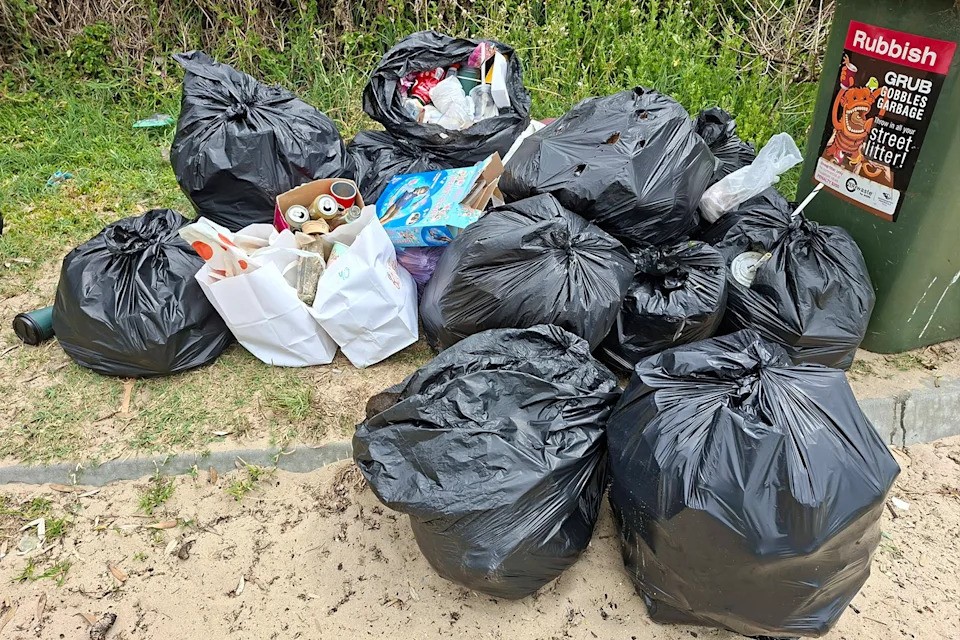
When bins overflowed at a Mornington beach over the summer holidays, tourists simply dumped their garbage on the ground. Source: 3931 Mornington Beach Patrol
Radar system can detect metal cutlery in FOGO bins
There are competing systems that use cameras to scan rubbish and alert businesses or councils when the wrong item has been put in a bin.
Matter’s system is being developed to do the same, but it uses radar instead to detect the unique shape-signature of items.
“For example, if a knife or a fork was in a food bin, it would identify that,” he said.
“It will even identify plastic bags in a battery bin,” he added.
The Aussie state that is the WORST at using yellow bins revealed
Sad detail in photo of university campus highlights tragic Aussie trend
Silence following 400,000-hectare natural disaster sparks suspicion
Sydney is on track to run out of landfill space in just five years. And businesses around Australia are under increasing pressure to quantify how much waste they are producing.
Luxford explained the next step will be to make the bins feed into accounting software like Xero, so the bin activity is automatically detailed, ready for inclusion in annual reports.